
Key judgments
- High confidenceThe attackers could send messages through ASOS’s customer-messaging channel on 6 October. ASOS confirmed the unauthorised notification, said the activity involved third-party platforms it uses to communicate with customers, and restricted access to its notification platforms.
- High confidenceThe public pressure was prepared before the push. Our collection shows the group’s “gateway” channel posting at 08:30 BST and its main channel welcoming readers at 09:23, about 90 and 37 minutes before the notification, with a fallback ready in case the channel was taken down.
- No assessmentWe cannot say whether ASOS’s Snowflake account was accessed. The group has offered no sample. Snowflake’s statement that its platform was not compromised answers a different question: in 2024 the platform was not breached either, yet about 165 customers’ accounts were entered with stolen credentials.
- Moderate confidenceThis is a repeatable playbook, and it worked nine months ago. Betterment lost its marketing platforms to one voice-phishing call; the rogue message reached 460,000 customers and the data was on a leak site 14 days later. Systems that can message every customer need the identity controls of a payment system.
- High confidenceASOS customers face follow-on fraud whatever the outcome. ASOS accounts were offered on criminal forums all year for as little as $5, alongside ASOS-specific credential lists; any contact data taken now would make phishing about this incident more convincing.
- from the extortion channel’s first post to the push notification
- ≈90 min
- posts in the group’s main channel on 6 October — none with a data sample
- 4
- active ASOS customers, by the company’s own count
- 16.5m
- from Betterment’s rogue message to its data on a leak site, in January
- 14 days
At about 10:00 on 6 October 2026, people with the ASOS app on their phones received a notification headed “ASOS HACKED”. It was not addressed to them. It was addressed to the company’s data protection officer and IT team: “we have fully compromised the Snowflake instance. Engage with us, or we will leak it.” Malwarebytes and others reported it within hours, and that afternoon ASOS told the London Stock Exchange that names and contact details may have been accessed. This analysis adds the attackers’ side from our own collection — every post in their channels, with timestamps — separates what the notification proves from what the attackers claim, and sets it against the last time a company’s own customer channel was turned against it.
| Status | Finding | Source |
|---|---|---|
| Observed | An unauthorised notification reached ASOS app users at about 10:00 BST on 6 October. ASOS restricted access to its notification platforms and said names and contact details may have been accessed. | ASOS announcement, 6 Oct 2026 |
| Observed | The group’s gateway channel posted at 08:30 BST and its main channel at 09:23, before the push. The main channel made four posts that day, the last at 14:52; none carries a sample. | FireIntel DDW Advance collection |
| Observed | Snowflake said it had found no compromise of the Snowflake platform. | Snowflake statement, via Sky News |
| Assessed | The attackers held an account or key that could launch messages on at least one platform ASOS uses to reach customers. | ASOS announcement; Simon AI interview |
| Unknown | How access was gained, which platform was used, whether ASOS’s Snowflake account was accessed, what data was taken and who the group is. | Not established by any source |
What happened on 6 October
The notification went out at about 10:00 British Summer Time, by ASOS’s own account; BleepingComputer, whose readers sent it in, put it at about 5:00 a.m. Eastern. Customers’ reports suggest it reached many, if not all, app users. It carried a link to a Telegram channel. By late afternoon the app was showing its own notice telling customers to disregard the alert and not to follow the link.
- Attackers’ channel post
- Message to customers
- Official statement
- 08:30 · Channel
A “gateway” channel posts a link to the group’s main channel, so readers can find a replacement if it is taken down. The earliest post we found from either channel.
- 09:23 · Channel
The main channel introduces itself as Xuanye group’s official broadcast outlet, warns readers about impersonators and gives a contact handle.
- ≈10:00 · ASOS
ASOS app users receive “ASOS HACKED”, addressed to the company’s data protection officer and IT, with a link to the channel.
- 10:57 · Channel
“Regarding ASOS, payment information is not affected.” ASOS said the same about payment cards that afternoon.
- 10:58 · Channel
“That is all for now.”
- 14:52 · Channel
Says the app is safe, the customer information is “safe on our server” and will not be touched “for a designated period”, and asks to be thanked for its clarity.
- 15:15 · ASOS
ASOS’s announcement to the London Stock Exchange: an unauthorised notification, unauthorised activity on third-party messaging platforms, names and contact details possibly accessed.
ASOS’s stock-exchange announcement at 15:15 confirmed “an unauthorised customer notification”, said the company was investigating “unauthorised activity involving third-party platforms that we use to communicate with customers”, and said it had restricted access to “the notification platforms”. It added that basic personal information “including name and contact details may have been accessed”, that it did not believe payment-card information or passwords were affected, and that its website and app were operating normally. The NCSC published guidance the same day telling every ASOS customer to assume they were affected, whether or not they had received the notification.
What the attackers’ channel shows
Our collection holds the group’s output from 6 October: four posts in its main channel and one in the “gateway” channel that points to it. Their timestamps put the channel ahead of the notification, not behind it.
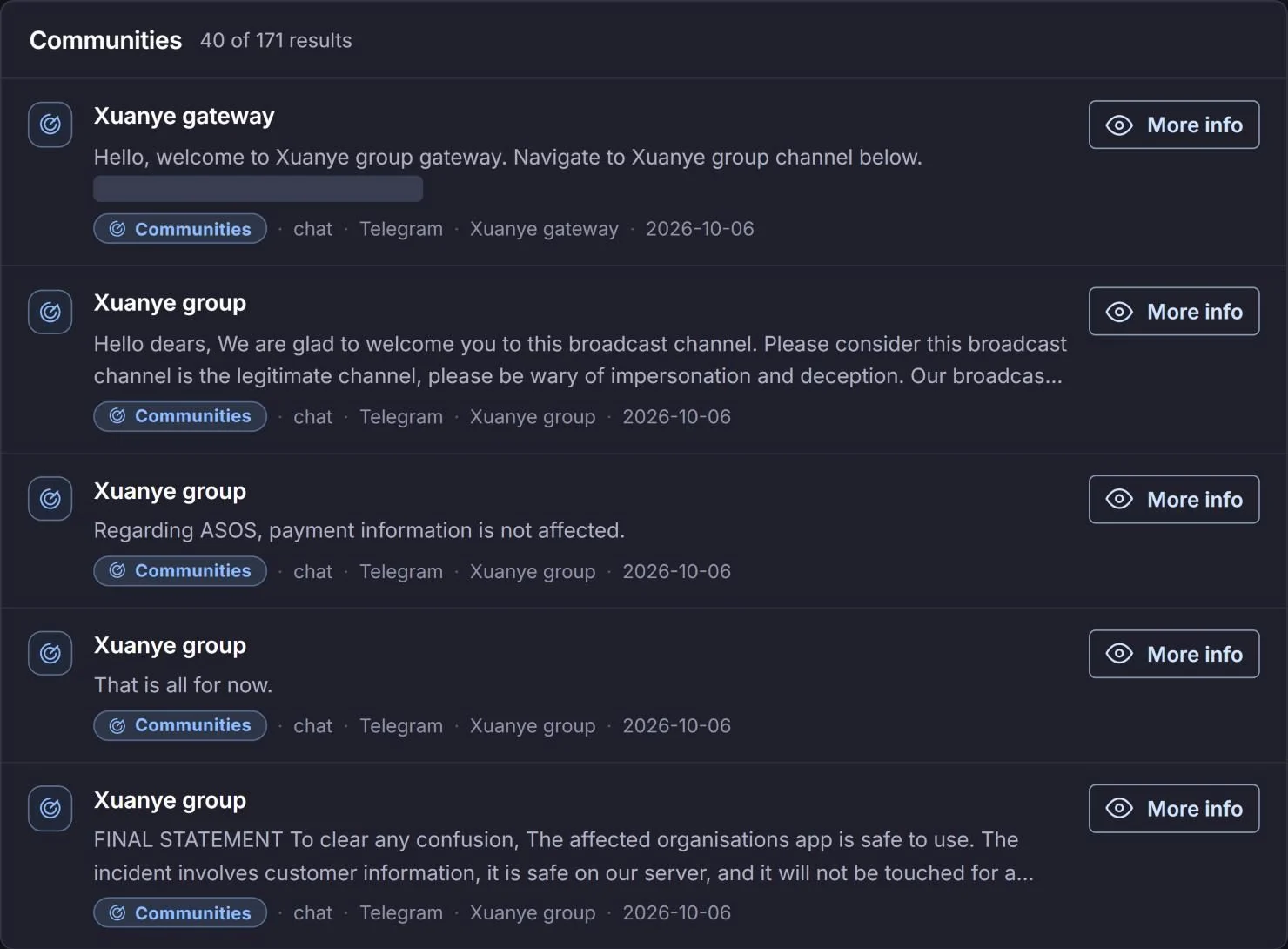
| Posted (BST) | Channel | What it said |
|---|---|---|
| 08:30 | Gateway | “Hello, welcome to Xuanye group gateway. Navigate to Xuanye group channel below” — and a link |
| 09:23 | Main | Introduces the “legitimate” broadcast channel, warns of impersonation, says the link will be updated in the gateway if the channel is removed, and gives a contact handle |
| 10:57 | Main | “Regarding ASOS, payment information is not affected.” |
| 10:58 | Main | “That is all for now.” |
| 14:52 | Main | “FINAL STATEMENT”: the app is safe to use; the customer information “is safe on our server, and it will not be touched for a designated period”; “you can thank us for our generous clarity” |
Quotations are the group’s own words. Times are converted from the posts’ UTC timestamps. The main channel’s posts carry message numbers 2 to 5.
Three things stand out. First, it was planned. The gateway was posting by 08:30 and the main channel had welcomed readers by 09:23, about 90 and 37 minutes before the notification. The welcome post warns of impersonators and promises that a replacement link will appear in the gateway if the channel is removed: the group expected a takedown and prepared for one before it acted.
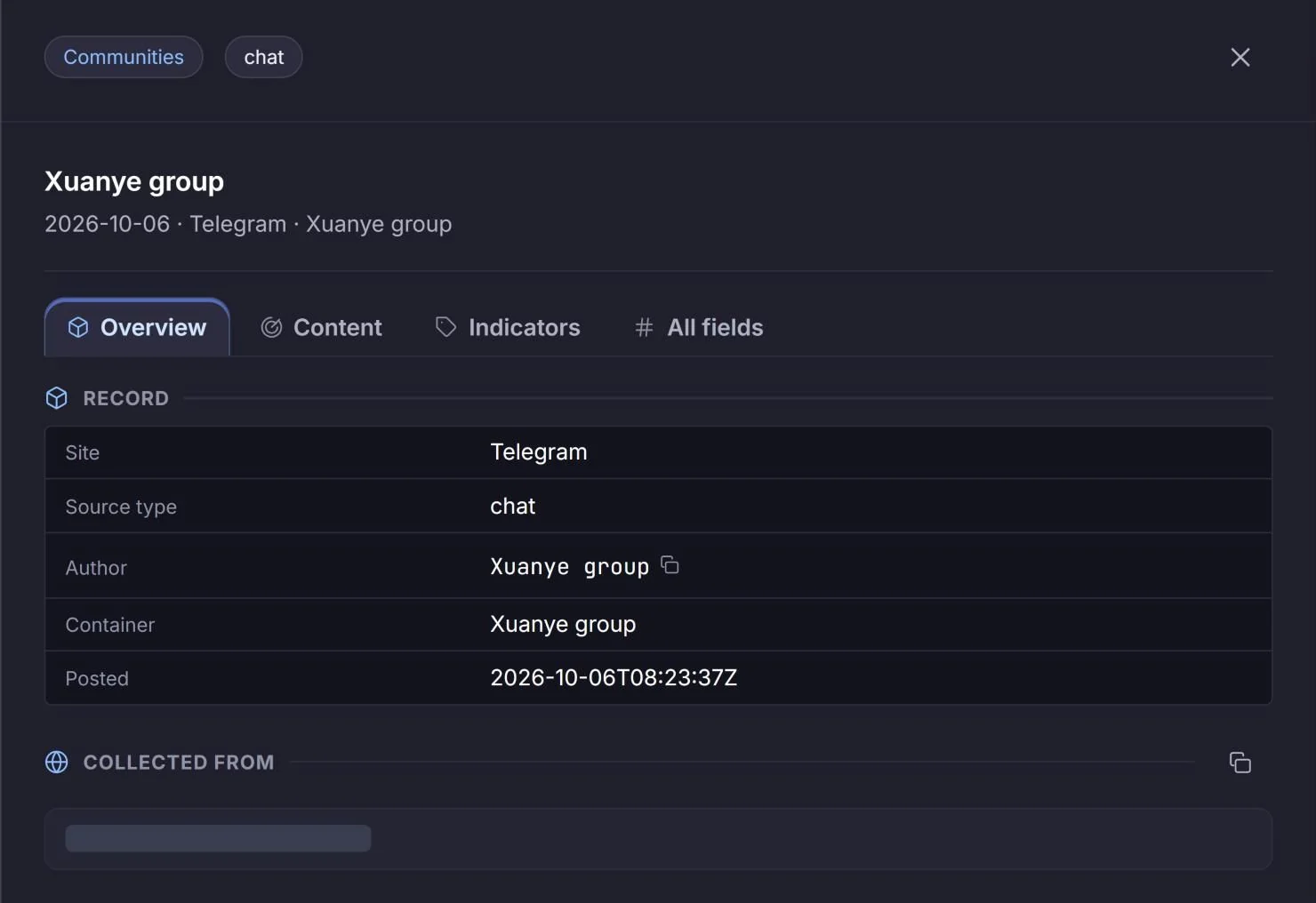
Second, it spoke early. Within the hour the channel was telling readers that payment information was not affected; ASOS said the same about payment cards in its announcement at 15:15. Third, it offered nothing that can be checked. None of the posts carries a sample, a file listing or a count. The final statement sets a deadline without a date — “a designated period” — and casts the whole episode as a disclosure for which readers should be grateful. BleepingComputer, trying to reach the group, found that the only contact point required payment.
The name is the only other clue, and a weak one. Xuanye (玄燁) was the personal name of the Kangxi Emperor, who ruled China from 1661 to 1722, as Computer Weekly noted; a name costs nothing to adopt. Computer Weekly described the group as previously unobserved, and the earliest post we found from either channel is the gateway post at 08:30 on 6 October. We make no attribution.
What the notification proves, and what it doesn’t
The notification and the claim point at different systems. In a June 2025 interview published by Simon AI, ASOS’s CRM lead described how the company’s marketing messages are built: behavioural, transactional and demographic data in one customer profile in Simon, which runs on Snowflake; audiences defined in SQL; and those audiences passed “straight into Braze, where we have pre-configured campaigns ready to activate.”
To put a message on every customer’s lock screen, an attacker needs the ability to launch a campaign in the messaging layer: an account or an API key with send rights. That is what ASOS’s own words describe — unauthorised activity involving “third-party platforms that we use to communicate with customers”, and restricted access to “the notification platforms”. It does not require the data warehouse. Conversely, holding Snowflake data would not let anyone send a push. The notification proves the first kind of access; the group asserts the second.
Snowflake’s response should be read the same way. It told Sky News it had “found no compromise of the Snowflake platform”. In 2024 that was also true, and Mandiant still found about 165 organisations whose Snowflake instances had been entered with stolen credentials — at least 79.7% of the accounts used had prior credential exposure, mostly through infostealer malware; none of the instances required MFA, and some credentials had not been changed for four years. Snowflake has since begun retiring single-factor password sign-ins. Its statement rules out a flaw in the platform; it neither confirms nor rules out stolen credentials used against ASOS’s own account.
It has happened before, and this is what followed
The first well-known case was a prank. In July 2021 the official Formula 1 app sent users “foo”, then “Hmmmm, I should check my security.. :)”. F1 said the targeted attack “was limited to the Push Notifications Service” and that it had “no reason to believe that any customer data has been accessed”.
The closest precedent is nine months old, and the company concerned has published the full sequence. On 9 January 2026 a caller spoofing “Betterment IT” obtained an employee’s credentials and a one-time code (T1566.004), registered a new device with the company’s Okta single sign-on (T1098.005) and opened the web applications Betterment uses for marketing and operations. At 17:46 Eastern a fake crypto offer went to about 460,000 customers by email and push. The account in the marketing application was suspended 19 minutes later. Betterment’s report lists what followed.
- Reached customers, or data published
- Pressure on the company
- FireIntel collection
- 9 Jan 2026 · Betterment
After a voice-phishing call, a crypto scam is sent to about 460,000 customers by email and push. The account in the marketing application is suspended 19 minutes after the send.
- 12 Jan 2026 · Betterment
A criminal group demands a crypto payment. Betterment declines to engage.
- 13 Jan 2026 · Betterment
Intermittent outages of the website and app from 09:04 to 14:40 Eastern.
- 14–16 Jan 2026 · Betterment
Employees receive threatening messages and harassment.
- 23 Jan 2026 · Betterment
Data from the incident is published on a .onion leak site, since removed.
- 26 Jan 2026 · Betterment
Reposted on the Spear forum as “Betterment Database | ShinyHunters”, claiming 20,000,000 lines. Betterment’s own count was data on about 1.4 million customers and business contacts. FireIntel collection.
- 6 Oct 2026 · ASOS
The rogue notification is itself the demand: public, addressed to the company, sent to its customers.
- 7 Oct 2026 · ASOS
As of publication we have seen no data from the group, and its only deadline is “a designated period”.
An extortion demand came on 12 January, a denial-of-service attack on the 13th, threats to employees from the 14th to the 16th, and on the 23rd the data — names, or names and email addresses, for most of the 1.4 million customers and business contacts affected — appeared on a .onion leak site. Our collection picks it up three days later, reposted on the Spear forum under the title “Betterment Database | ShinyHunters” and described as 20,000,000 lines. Leak titles inflate, and a group name in a thread title is a claim, not evidence. Nothing links the January attackers to Xuanye.
| Incident | What customers received | How access was gained | What followed |
|---|---|---|---|
| Formula 1, July 2021 | “foo”, then a taunt about security | Not disclosed; F1 said the attack was limited to its push notification service | No customer data accessed, according to F1 |
| Betterment, January 2026 | A fake crypto offer to about 460,000 customers, by email and push | A voice-phishing call for credentials and a one-time code; a new device registered in Okta | Demand, denial of service, threats to staff; data on a leak site after 14 days |
| ASOS, October 2026 | “ASOS HACKED” — an extortion demand addressed to the company | Not disclosed | No data sample published as of 7 October |
The ASOS message differs in one respect that matters. Betterment’s attacker used the channel to defraud customers; the ASOS message used it to embarrass the company in front of them — extortion in public rather than in private, with the audience as the lever. For any brand the lesson is the same. The systems that can message every customer at once can do as much damage as a payment system, and deserve the same identity controls.
ASOS accounts were already for sale
Separately from this incident — we found nothing that connects the two — ASOS customer accounts have been a commodity on criminal forums all year. A search of the forums in our collection on 7 October returns posts from January to September 2026 offering ASOS accounts or ASOS-specific credential lists.
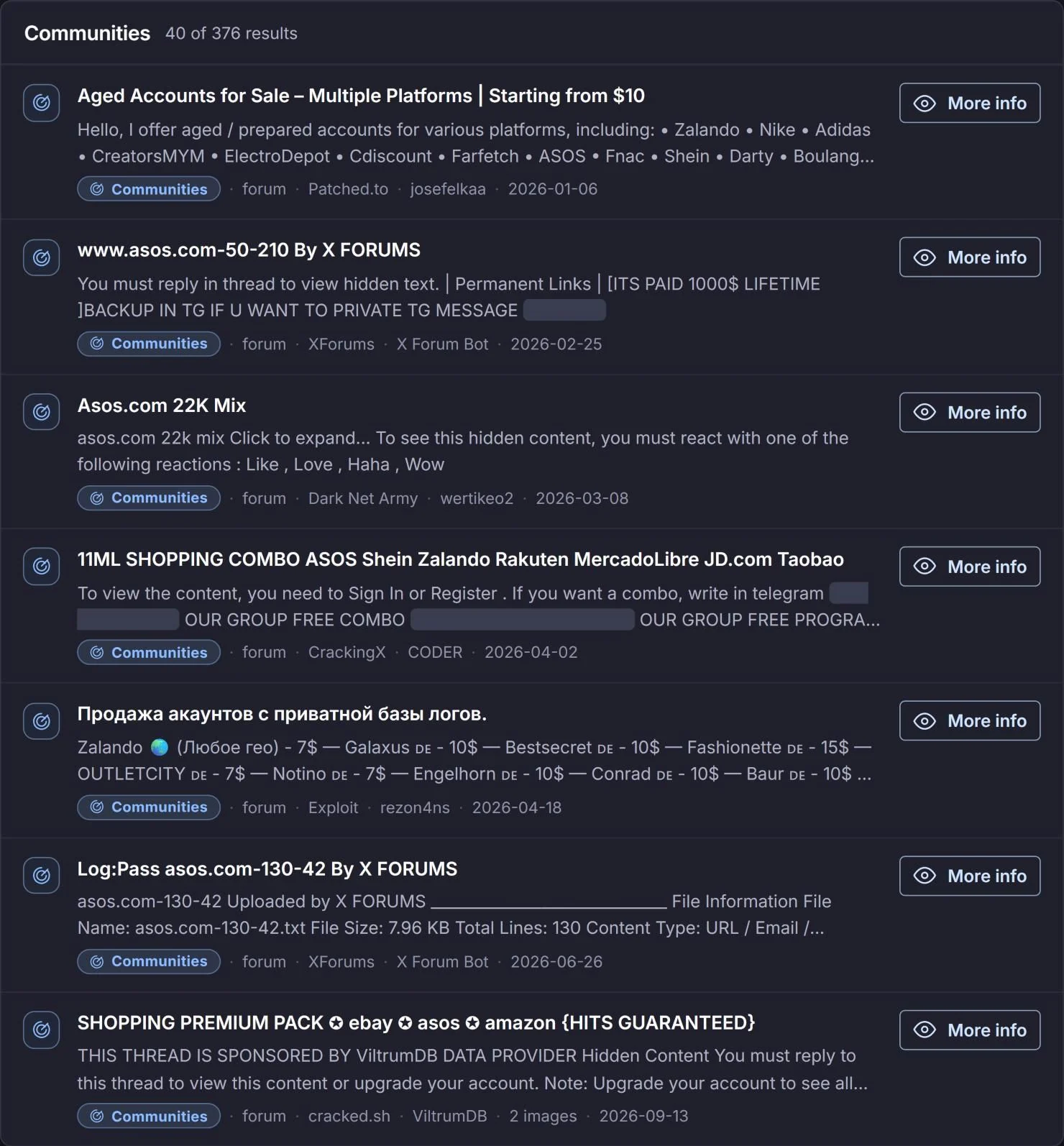
The offers take three forms. Ready-made accounts: on Exploit in April, a seller priced ASOS accounts in any country at $5 from what the post calls a private base of logs — infostealer logs, harvested from infected computers. Credential lists: an automated account on XForums posted ASOS login lists in February and June, the second of 130 lines of login URL, email and password, and a list billed as a 22K ASOS “mix” appeared on Dark Net Army in March. And ASOS as one name among many in multi-million-line shopping combolists and aged-account shops.
On 28 July ASOS detected credential stuffing against US customer accounts. Its notification letters, dated 21 August, said attackers had used login credentials “sourced from outside ASOS” and may have seen names, addresses, phone numbers, dates of birth and partial card details (CyberInsider). Lists like those above are the raw material for that kind of attack. They also mean that any contact data taken now lands in a market that already holds passwords for some of the same people — the conditions for convincing phishing about “the ASOS hack”.
Mapped to MITRE ATT&CK
| Status | Technique | Basis |
|---|---|---|
| Confirmed | T1491.002External Defacement | A hostile message delivered to customers through the company’s own app — the nearest ATT&CK fit for a hijacked notification channel. |
| Confirmed | T1657Financial Theft | An extortion demand: “Engage with us, or we will leak it.” No payment is known. |
| Observed | T1583.006Web Services | Two Telegram channels set up before the push to publicise the demand and survive a takedown (FireIntel collection). |
| Assessed | T1078.004Cloud Accounts | Launching a campaign needs a valid account or API key on a messaging platform. How it was obtained is not known. |
| Claimed | T1213.006Databases | “Fully compromised the Snowflake instance.” ATT&CK lists Snowflake under this technique. No evidence offered. |
IDs follow MITRE ATT&CK version 19.2 and were checked against MITRE’s published data. “Claimed” records what the attackers say, not what is known; “Assessed” is our inference from ASOS’s statement.
What to do
If you run a customer-messaging stack
- Put every marketing and messaging platform behind single sign-on with phishing-resistant MFA, and remove local logins. After January, Betterment retired every MFA method that was not hardware-based.
- Treat a new MFA factor or device registration as a high-risk event. At Betterment it was the step between a phone call and the marketing platforms; alert when one is followed by access to messaging tools.
- Scope API keys narrowly and pin them to known addresses. Braze, for example, lets a REST API key carry only the permissions it needs and only accept requests from listed IP addresses. Neither can be changed after the key is created, so audit keys made for agencies and pilots that have outlived their purpose.
- Separate the right to send from the right to export. An account that launches campaigns rarely needs to export audiences, and the reverse.
- Watch the platform’s own audit trail — sign-ins, new users, new API keys, campaigns launched outside a schedule — in your SIEM, not only in the vendor’s console. Braze can export its security events to cloud storage daily.
- Know your kill switch: who can revoke platform access and pause every campaign, and how quickly. Betterment suspended the attacker’s marketing-application account 19 minutes after the rogue send; rehearse doing it faster.
If your customer data is in Snowflake
Whether or not ASOS’s Snowflake account was touched, the claim is a reminder of the 2024 pattern. The queries below hunt for it in Snowflake’s own account-usage views: password-only sign-ins and sign-ins from new addresses; sessions that stage and unload data the way Mandiant described; and client applications appearing for the first time — the 2024 attackers used DBeaver Ultimate, which identifies itself in the session’s client environment. Each query was parsed with a Snowflake-dialect SQL parser and every column checked against Snowflake’s documentation for its view. None has been run against live data for this post; treat the results as leads to review, not alerts.
WITH logins AS (
  SELECT event_timestamp, user_name, client_ip, reported_client_type,
         first_authentication_factor, second_authentication_factor
  FROM snowflake.account_usage.login_history
  WHERE event_timestamp > DATEADD(day, -120, CURRENT_TIMESTAMP())
    AND UPPER(is_success) = 'YES'
),
first_seen AS (
  SELECT user_name, client_ip, MIN(event_timestamp) AS first_login
  FROM logins
  GROUP BY user_name, client_ip
)
SELECT l.event_timestamp, l.user_name, l.client_ip, l.reported_client_type,
       l.first_authentication_factor, l.second_authentication_factor,
       l.event_timestamp = f.first_login AS new_address_for_user
FROM logins AS l
JOIN first_seen AS f
  ON f.user_name = l.user_name AND f.client_ip = l.client_ip
WHERE l.event_timestamp > DATEADD(day, -30, CURRENT_TIMESTAMP())
  AND ((l.first_authentication_factor = 'PASSWORD' AND l.second_authentication_factor IS NULL)
       OR l.event_timestamp = f.first_login)
ORDER BY l.event_timestamp DESC;SELECT session_id, user_name, role_name,
MIN(start_time) AS first_statement, MAX(start_time) AS last_statement,
COUNT_IF(query_text ILIKE '%temporary stage%' OR query_text ILIKE '%temp stage%') AS temporary_stages,
SUM(rows_unloaded) AS rows_unloaded,
COUNT_IF(query_text ILIKE 'get %') AS downloads
FROM snowflake.account_usage.query_history
WHERE start_time > DATEADD(day, -30, CURRENT_TIMESTAMP())
AND UPPER(execution_status) = 'SUCCESS'
GROUP BY session_id, user_name, role_name
HAVING COUNT_IF(query_text ILIKE '%temporary stage%' OR query_text ILIKE '%temp stage%') > 0
AND SUM(rows_unloaded) > 0
ORDER BY rows_unloaded DESC;WITH s AS (
SELECT created_on, user_name, client_application_id,
PARSE_JSON(client_environment):APPLICATION::STRING AS application
FROM snowflake.account_usage.sessions
WHERE created_on > DATEADD(day, -120, CURRENT_TIMESTAMP())
)
SELECT COALESCE(application, client_application_id) AS client,
MIN(created_on) AS first_seen,
COUNT(DISTINCT user_name) AS users,
ARRAY_AGG(DISTINCT user_name) AS user_names
FROM s
GROUP BY COALESCE(application, client_application_id)
HAVING MIN(created_on) > DATEADD(day, -30, CURRENT_TIMESTAMP())
ORDER BY first_seen DESC;- Require MFA for every human user, and key-pair or OAuth authentication for service users; Snowflake is retiring single-factor passwords for people, and users of type SERVICE cannot sign in with a password at all.
- Use network policies so that each account can be reached only from the addresses you expect. None of the instances in the 2024 campaign had them.
- Rotate credentials that have not changed in years. Mandiant found some in the 2024 campaign unchanged for four.
Detection content
- Snowflake hunting queries The three queries above, with notes; for any Snowflake account
If you are an ASOS customer
- The UK’s National Cyber Security Centre advises every ASOS customer to assume they are affected, whether or not they received the notification.
- Do not open the Telegram link in the notification. ASOS’s in-app notice says the same.
- Expect phishing that uses this incident: messages about refunds, compensation or “securing your account”. Go to the app or the website directly rather than following a link.
- If you use your ASOS password anywhere else, change it there too. ASOS credential lists were circulating before this incident.
Method, confidence and limits
This analysis was written on 7 October 2026, the day after the incident began, and will date quickly. ASOS’s account comes from its stock-exchange announcement; Snowflake’s from its statement to Sky News, as reported by InternetRetailing; ASOS’s marketing stack from its 2025 interview with Simon AI; Betterment’s sequence from its own post-incident report; and the 2024 Snowflake campaign from Mandiant. The Telegram posts, the Betterment forum repost and the ASOS account market come from FireIntel’s DDW Advance collection, queried on 7 October 2026.
Confidence follows common intelligence practice. High confidence means the judgment rests on direct observation or on several independent sources that agree. Moderate means the evidence is credible but incomplete, or comes from one source or from a party with a motive to exaggerate. “No assessment” means we lack an independent basis to judge.
Screenshots were captured from the FireIntel console on 7 October 2026. The group’s channel link and record source links, and the sellers’ contact details, are covered with bars, because they lead to the extortionists and the sellers; beyond choosing and ordering which posts to show, nothing in them was altered. There are no technical indicators to publish: the only attacker infrastructure we observed is the two channels.
Sources
- ASOS plc — Update regarding cyber incident, London Stock Exchange announcement (6 October 2026)
- National Cyber Security Centre — Incident affecting ASOS customers (6 October 2026)
- Malwarebytes — ASOS “hackers” send push notifications to customers (6 October 2026)
- BleepingComputer — ASOS confirms data breach after “HACKED” in-app notifications (6 October 2026)
- Computer Weekly — Asos app users receive threatening messages after hack (6 October 2026)
- InternetRetailing — ASOS admits that “basic personal information” may have been accessed, with Snowflake’s statement (6 October 2026)
- Simon AI — How ASOS uses AI to personalize fashion for 20 million customers (9 June 2025)
- Betterment — Security Incident Report: January 2026 (updated 30 March 2026)
- Mandiant — UNC5537 Targets Snowflake Customer Instances for Data Theft and Extortion (10 June 2024)
- Snowflake — Planning for the deprecation of single-factor password sign-ins
- The Register — F1 app push notification attack (5 July 2021)
- CyberInsider — ASOS credential-stuffing attack notification (24 August 2026)
- Braze — APIs and identifiers: REST API key permissions and IP allowlisting
- Braze — Exporting security events to cloud storage
- Datadog Security Labs — A guide to threat hunting and monitoring in Snowflake
Follow FireIntel on Telegram
New research from FireIntel Threat Research, on our official channel.